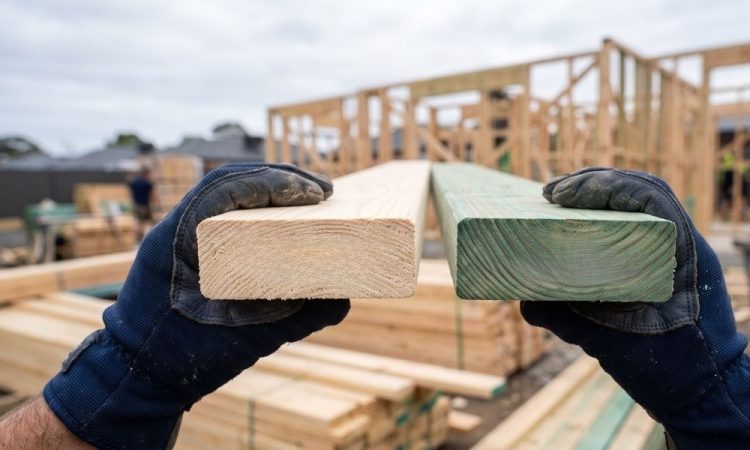
Most arguments about structural pine on a building site confuse three separate specifications. Strength grade, treatment level, and appearance each describe a different property of the same board.
A single stick can carry a high grade and a low hazard class at the same time, and knots can cover its face without changing either. The myths below all come from reading one system as if it were another.
Three systems, one stick of timber
The grade stamp describes strength and stiffness. It tells the engineer how the board behaves under load, and it feeds directly into span tables.
The treatment mark describes durability. It records which hazards the board is protected against, from termites inside a wall to decay in the weather.
Appearance is surface information only. Color and grain pattern say nothing reliable about how a board behaves under load.
All three marks sit on the same piece, which is where the confusion starts. A buyer sees blue dye and assumes strength, or sees knots and assumes weakness.
Mixing them up on site has real consequences. An H2 board exposed to the weather fails inspection, whatever its grade.
Myth 1: knots and color variation mean weak timber
The grade on modern structural pine is mechanical, not visual. Under MGP grading, every stick passes through a machine that bends it and measures deflection.
That deflection produces the Modulus of Elasticity, the stiffness value behind MGP10 and MGP12.
The machine tests the actual piece, knots and all.
Stiffness is the primary measurement, and bending strength is verified alongside it. MGP10 is the common grade for residential wall framing in Australia. Its rating exists because the weakest measured property of the piece still clears the threshold.
Sapwood and resin streaks change how a board looks without changing how it bends. Color is even less informative than knots.
The result is predictable engineering performance, with design properties for an MGP grade taken from the applicable design documentation.
Visual rules still apply, and graders reject pieces with defects outside set limits. But the stamped grade itself comes from the machine.
Myth 2: F-grades and MGP grades are interchangeable
F-grading is the older system, and it still runs alongside MGP. A trained grader assesses each piece by eye against visual rules.
Density and defect size drive the result. F5 and F7 stamps remain common on older plans and in older span tables.
MGP grading replaces that estimation with measurement. Each stick is tested non-destructively, and the stamp records the grade that its measured stiffness supports.
AS 1720.1 sets the design properties engineers use in timber structure calculations. Machine grading supplies those properties directly, which is why calculated designs specify MGP grades.
AS 1684 governs residential timber-framed construction and publishes the span tables. Those tables list grades from both systems, and the frame on site must match what the designer specified.
Swapping an F grade for an MGP grade assumes the two scales align. They rest on different evidence, so any substitution needs the design and product documentation to support it.
Myth 3: treated pine suits every application
Treatment is specified by hazard class, and the classes run from H1 to H6. Each class matches a defined level of exposure.
H2 protects internal framing against termites. It carries a blue dye identifier and belongs inside a dry building envelope.
H3 covers external, above-ground use. It adds protection against decay, borers, and termites for timber exposed to weather.
H4 covers timber in direct contact with the ground. Blue H2 framing used outside will decay, because its treatment was never rated for wet exposure.
Proprietary products such as SupaPine are engineered for above-ground exterior applications. They exist because internal treatment levels cannot do that work.
Inspectors check dye and brand marks against where each member sits. The class on the stick must match the exposure on site.
Compliance starts at the yard. For Western Australian residential work, check the Structural Pine Perth product range for available grades and hazard classes, and compare the product information with the plans before confirming the specified grade and treatment.
Myth 4: CCA treatment is banned and dangerous
CCA, copper chrome arsenate, is a waterborne preservative with a long record in outdoor structures. It is not banned.
Its use is restricted in high-contact applications, including playground equipment, domestic decking and handrails.
Whether CCA-treated pine suits a given application depends on the product’s documentation and the project specification. Neither the treatment nor the grade carries a safety guarantee on its own.
A retaining wall or sub-floor sees almost no routine skin contact. Playground equipment sees constant contact, and the regulation draws its line there.
CCA remains one of the most durable treatments available for outdoor structural timber, and that durability is why it has stayed in specifications.
Handling follows standard trade safety measures. When handling or cutting it, follow the product’s safety data sheet for protective equipment and dust control.
Myth 5: treatment makes pine waterproof and warp-proof
Preservative treatment works on biology. It protects the board against decay fungi and insects, and its job ends there.
Water is a separate problem, and treatment does nothing for it. Treated pine absorbs and releases moisture like any other timber, and it moves as moisture levels change.
That movement is what warps and twists a frame. No hazard class prevents it.
Treatment carriers differ in how they handle moisture. LOSP uses a light organic solvent, and the timber stays dry through the process.
LOSP is the common choice for precision-cut components. The solvent carrier doesn’t swell the wood it treats.
CCA is waterborne, so the timber is wet during treatment and dried again afterward. Either way, the finished board still responds to site weather.
Acclimatization comes before fixing. Timber installed wet and dried in place moves against its fixings.
Storage is what actually protects the timber from moisture damage. Keep packs flat and covered, let the timber acclimatize, and seal surfaces where the plans specify.
Myth 6: the blue dye on H2 pine is toxic
The blue pigment is a marker, not an active ingredient. It exists so building inspectors can identify H2 timber at a glance.
The active chemical varies by product, and the treatment information on the timber identifies the actual preservative used. That information, not the dye color, is the source for what the board contains.
H2 is an envelope treatment, and the preservative penetrates only the outer shell. The inner core stays untreated.
Trades cut H2 pine every day under standard precautions. Use the dust controls and PPE specified in the safety data sheet when machining the timber.
Dust extraction helps control airborne wood dust. Check the product guidance before cutting, drilling or sanding treated timber.
Myth 7: cut ends and drill holes need no resealing
Every cut through envelope-treated pine exposes untreated wood. The core of the board carries no preservative at all.
Drilled holes and notches open the same path on a smaller scale. Termites and moisture only need one entry point.
Where the product instructions require it, the fix is a brush-on preservative sealer applied on site. It restores the envelope that the saw or drill bit broke.
Check the treatment system’s manufacturer instructions before sealing any cut end. Those instructions set the resealing requirement for the product in use.
The sealer is a standard trade product, stocked wherever treated timber is sold.
This applies to H2 and H3 stock alike. Any treatment that forms an envelope can be breached, and the breach is where failure starts.
Where resealing is required, it keeps the protection the treatment plant applied.
Myth 8: pine is inferior to steel and concrete
The comparison usually ignores weight. Structural pine offers high strength for its mass, and a framed wall stays light enough to handle by hand.
A lighter frame asks less of everything below it. Footings and lifting gear both scale with the weight they carry.
Light members move without cranage, and wall frames go up with small crews. That is where the speed advantage comes from.
Timber also flexes under load. In seismic zones, a framed structure absorbs movement through its joints, and that flexibility protects the building.
On-site modification is the daily advantage. A carpenter trims and fixes pine with ordinary hand tools, with no welding and no formwork.
Plantation pine stores carbon in the finished frame. Production footprints vary by product and by how the materials are compared.
Steel and concrete suit long spans and heavy loads. Residential framing rarely demands either, and pine’s strength-to-weight ratio covers the work.
Myth 9: structural pine comes from old-growth forests
Most structural pine in Australian construction is plantation-grown. The species, origin and any certification for a given piece should be confirmed from the product records.
Radiata Pine grows fast and accepts preservative readily. That treatability is a large part of why it dominates structural supply.
Plantations supplying the framing market are regulated and certified. Harvested areas are replanted, and the resource is managed as a renewable crop.
Each harvested area returns to trees, and the next crop is already growing. That is what renewable means in this context.
Growing trees sequester carbon from the atmosphere. Milled into framing, that carbon stays stored in the building for its service life.
The framing market runs on these rotations. Old-growth forests are not the source, and the supply chain doesn’t depend on them.
Grade, hazard class, and standard are printed on every stick of compliant framing. Match those marks to the plans, store the packs with care, and treat cuts as the product instructions direct.